Products
Knowledge & Support
Explore our Knowledge Hub:
Tips & Advice Education Area Case Studies The Grant House Virtual House FAQs Glossary Visit the Knowledge HubProducts
Knowledge & Support
Explore our Knowledge Hub:
Tips & Advice Education Area Case Studies The Grant House Virtual House FAQs Glossary Visit the Knowledge HubSmart Thermostats vs Traditional Heating Controls: A Homeowner’s Guide
Smart thermostats and traditional heating controls help homeowners manage their heating schedules and preferred room temperatures. Traditional heating controls provide straightforward temperature and timing control without remote app access whereas smart thermostats and controls have additional features which allow for remote adjustment and more sophisticated connectivity with other systems. Traditional heating controls and smart heating controls each work effectively to manage central heating systems (including air source heat pumps and oil-fired boilers) and the right choice for your home will depend on your heating system, your household’s routine and your preferred way of managing comfort.
Heating controls play an important role in all types of home heating systems because they manage the operation of the heat source and help ensure that your desired room temperatures are achieved. Traditional heating controls are typically set and controlled manually whereas smart controls and thermostats can connect to the internet and be managed by an app or other third-party digital platforms. Smart thermostats and controls offer additional convenience but correctly set-up traditional controls are still a popular and effective way to manage a heating system.
This guide is designed to help homeowners compare the differences between traditional and smart heating controls, covering functionality, benefits, practicality and suitability. Whether you have a heat pump or boiler, this blog will have insight and guidance for you and your household.
Quick links in this guide…
In this blog, we will explain:
What are traditional heating controls?
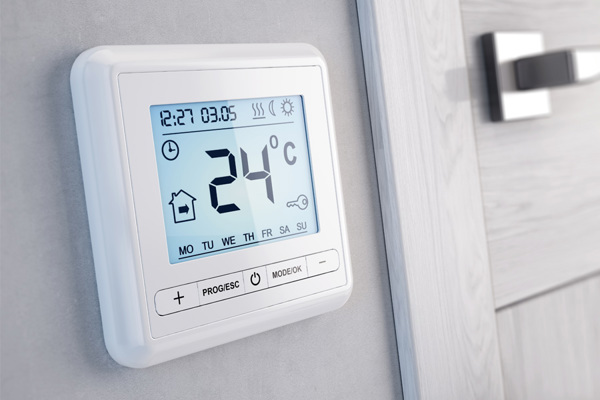
Traditional heating controls manage heating schedules, temperatures and operating times and often include several components including thermostats, programmers and radiator valves. A traditional heating control programmer will be a wall-mounted device featuring a simple display screen and navigation buttons and will typically be hard-wired to other components. While not as sophisticated as smart controls, traditional heating controls can be modern in styling and offer a range of functions, except remote connectivity.
A heating system using traditional heating controls will usually feature one or more of the following components which each has its own role within the system:
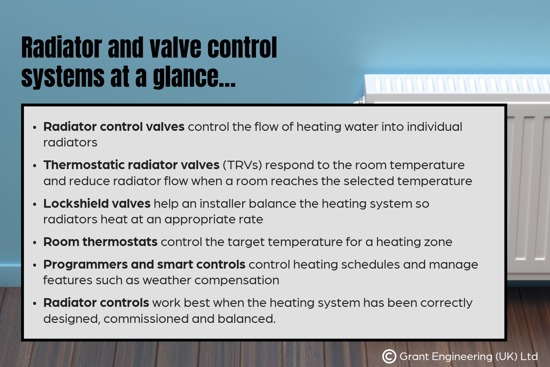
Wall-mounted, hard-wired controller or programmer – the main control hub or programmer for managing space heating and hot water scheduling
One or more room thermostats – these control the target or desired temperature for a particular heating zone, for example upstairs and downstairs
Radiator control valves – radiator valves (such as manual valves or TRVs) control the flow of water into individual radiators to provide tailored room-by-room adjustments
Lockshield valves – these help balance the wider heating system to evenly distribute heat throughout all radiators.
What is a smart thermostat?
A smart thermostat is a heating control which can be connected to the internet and remotely managed by homeowners using a supporting app or other digital platform. Smart thermostat controls can be remotely accessed allowing homeowners to adjust their room temperatures and schedules when away from the home. Depending on their specification, smart heating controls can also adjust settings automatically based on the weather, outdoor conditions and household behaviours and preferences.
The terms ‘smart thermostats’ and ‘smart controls’ are sometimes used interchangeably but their capabilities vary – here are some key differences:
A smart thermostat is usually a WiFi enabled room thermostat which controls the desired temperature for a particular heating zone. Smart thermostats can be connected to other WiFi enabled components within the heating system and can be controlled remotely via an app or online interface.
A smart controller is a more sophisticated smart thermostat with a greater level of functionality – it can serve the same function as a room thermostat, controlling a particular heating zone, but it can also manage other heating zones and wider parts of the heating system.
A smart radiator valve is a thermostatic radiator valve which can be electronically controlled using an app allowing households to control individual radiators remotely.
The range of smart heating controls available on the market is broad and each ‘smart’ product will be different – it is therefore important to check the individual specification and features of any smart controls you are considering for your home.
Provided below is a summary of the features of the Aerona Smart Controller supplied by Grant UK, a smart heating controller which is compatible with Aerona air-to-water heat pumps:
Use the controller interface or supporting app to set and change space heating and domestic hot water schedules using handy weekly or daily timed programming
Use the supporting web-based platform to access other controller settings remotely which can allow installers to provide remote diagnostic support for your heat pump
Using its in-built weather compensation functionality, the Aerona Smart Controller can adjust your heat pump’s operation based on the outdoor temperature
Provides temperature management for all your heating zones by pairing with compatible thermostats, but can also be a room thermostat for the particular zone it is located in.
How do smart thermostats and controls compare with traditional heating controls?
Smart thermostats and traditional heating controls share a number of functions including heating scheduling, setting temperature preferences and DHW scheduling. Smart thermostats and controls offer the additional benefit of WiFi connectivity to enable remote management and they are often more sophisticated than traditional heating controllers, featuring additional functionality which can improve system efficiency. Households with a routine that rarely changes may find a traditional programmer sufficient for their needs whereas households with variable routines who need to regularly change their heating schedules may benefit from opting for smart controls.
This comparison table provides a summary of the key differences between traditional heating controls and smart heating controls but, as mentioned previously, each product is different so check manufacturer specifications before installing.
Feature | Traditional heating controls | Smart heating controls |
|---|---|---|
Heating zone temperature changes | Adjust using a room thermostat via its interface/display | Adjust either via the controller interface/display or remotely via an app |
Adjusting heating schedules | Available to view and edit using the room thermostat or programmer | Available to view and edit using the controller interface/display or remotely via an app |
Remote access | Not usually available | Commonly available using either a supporting app or web-based platform |
Automated adjustments based on outdoor conditions and household routines | Standard weather compensation may be available, depending on the product and wider system components | Sophisticated weather compensation and heating curve adjustments available, depending on the product. Some may also have self-learning functionality as well |
Room-by-room control | Use TRVs and manual valves to make individual room adjustments | Use TRVs, smart radiator valves or WiFi connected room thermostats to make adjustments to rooms or zones via controller interface or remotely via an app |
Can a smart thermostat help reduce heating bills?
A correctly specified and configured smart thermostat may help a heating system to operate more efficiently by making schedules easier to manage, allowing a heating system to operate when needed and reducing energy waste. This can result in less energy or fuel being consumed but savings are not guaranteed. However, that is not to say that traditional heating controls will be less cost-effective – each heating system is different and what works best for one home may not be the right solution for another.
The outcome will depend on the property, heating system, existing controls, household behaviour and how the new controls are set up. Traditional heating controls can also be cost-effective when they are suitable for the system and used correctly.
Changing from traditional heating controls to a smart alternative is not the only solution for achieving greater system efficiency (and hopefully reducing energy or fuel consumption). A home could improve its energy efficiency by simply reviewing its existing controls and their settings or considering introducing TRVs for greater room-by-room control. The potential savings a household could make will depend on their starting point, how their controls are already being used and what additional functionality alternative controllers or stats could achieve.
Smart controls can improve heating system efficiency by:
Aligning heating scheduling with household needs to reduce unnecessary heating
Providing accurate temperature control using connected components in the wider system to prevent overheating or significant drops in temperature
Enabling remote access and control to facilitate schedule changes when needed
Responding to changes in the outdoor conditions by automatically adjusting the heat source’s operation – for example, when it is warmer outside, weather compensated smart controls can automatically reduce the system flow temperature, reducing demand on the heat source
Will a smart thermostat work with my heating system?
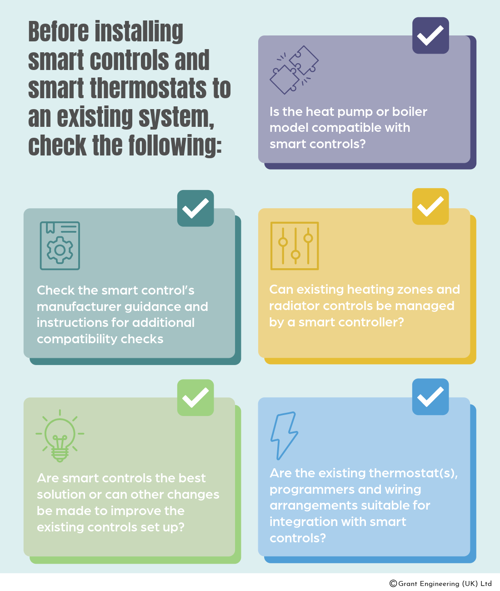
The addition of smart thermostats or controls to your existing heating system will depend upon several compatibility checks. Before installing a smart thermostat or completely upgrading your controls system to a smarter alternative, you should speak to your installer or heating engineer for further guidance. The type of heat pump or boiler you have may not be compatible with smart controls because the heat source itself needs the functionality to connect to such devices. The wider heating system components also need to be suitable for use with smart devices. The design of your system and its heating zones may also determine whether smart controls are going to be an option for your home.
If you are living with a Grant Aerona 290 heat pump, you will already having the Aerona Smart Controller managing your heating system. But if you have an Aerona³ heat pump using the standard controller, upgrading to the Aerona Smart Controller could be an option – read more about the Aerona Smart Controller here or speak to your heat pump installer.
Do heat pumps need different heating controls?
Air source heat pumps operate differently to traditional boilers so how they are controlled is also different. Heat pumps work best when operating at lower flow temperatures which refers to the temperature of the water running through your heating system. Consequently, heat pumps are more efficient when they can maintain steady room temperatures using a schedule of occupied and setback periods, instead of operating a simple on/off schedule.
Heat pump controls must facilitate certain parameters and conditions to allow the heat pump to operate correctly and most efficiently. A heat pump controller should:
Allow space heating and domestic hot water scheduling to be set so that they coordinate with one another and do not conflict
Enable weather compensation, if factored in during the system design, to allow the heat pump’s flow temperature to be adjusted according to the outdoor conditions
Support domestic hot water hygiene controls where required by the system design, including scheduled cylinder disinfection for legionella protection so that the cylinder’s water contents can be heated up in line with legionella protection guidance
Facilitate the addition of connected components, if factored in during the system design, to allow for room or heating zone monitoring and control of the heater emitters.
The Grant Aerona Smart Controller is an example of a smart heat pump heating system control. The Aerona Smart Controller manages heating and hot water schedules, can control more than one heating zone and circuit, can control radiator and underfloor heating circuits, is a weather compensated controller which installers can enable and adjust the heating curves to tailor each heating zone’s operation.
What should I check before choosing a smart thermostat?
As mentioned earlier in this blog, if you are thinking about adding smart thermostats to your existing system or upgrading your traditional controls to smart controls, you need to speak to your installer to carry out compatibility checks. Aside from these checks, it is also worth considering whether smart controls will enhance your lifestyle and routine or not.
Before choosing a smart thermostat or smart heating control system, ask yourself:
Does your household feel it needs additional control of your heating system or are your traditional, physical controls meeting your needs?
Would you benefit from being able to view and adjust your heating schedule when away from the home?
Is the internet connection in your home secure and reliable (smart controls depend on the internet)?
Would it be useful to have remote diagnostic support from your installer or heat pump manufacturer (the Aerona Smart Controller uses a dedicated web-based platform to allow installers and Grant UK’s Technical Team remote access to installed controllers, subject to homeowner permission being granted)
Does the smart controller require a hub or an additional subscription for use?
When are traditional heating controls a good choice?
Traditional heating controls are well suited to households who have a simple heating system operation which is effective at scheduling and temperature control. Households who prefer simple control displays or physical navigation buttons may also prefer traditional controllers over the touchscreen displays typically used with smart heating controls. Traditional heating controls are also a good choice for households with the same routine and who do not have a need for remote control, access and adjustments.
How can I get more from my existing heating controls?
There is more than one way you could get more from your existing heating controls. For some homeowners, upgrading or choosing smart heating controls will be the best way to achieve improved control of their heating system. For other households, traditional heating controls can still be used and, with some modifications, they could see changes in their heating system efficiency and temperature control.
For example, a household using traditional heating controls without TRVs could investigate adding TRVs to some of their radiators without changing their heating programmer or controls. The TRVs would allow for room-by-room temperature adjustments to facilitate tailored control which could minimise energy wastage, reduce energy or fuel consumption and deliver better comfort to the home.
There are also other simple checks or changes you can make to support the effective operation of your existing heating controls and wider heating system, including:
If your household routine changes, make sure your heating schedule is reviewed to suit your new routine
Ensure your radiators and radiator valves are clear of obstructions, such as furniture and curtains
If you have room thermostats, make sure they are correctly located – do not place thermostats close to radiators or other heat sources
If you have radiator controls, make sure they are used in coordination with other controls and that they do not conflict with the main thermostat
Read through your controller’s user instructions to ensure you are operating and maintaining your controls in line with manufacturer guidance.
Which heating controls are right for my home?
The right heating controls for your home will be the ones which best suit your heating system, household routine and preferred way of managing temperatures. Smart controls are worth considering if you want more flexible scheduling and remote access to control your heating system using an app. Whereas traditional programmable controls may be best if you prefer simple controls and have a straightforward heating operation. Whether you are considering traditional or smart heating controls, always seek the advice of your heating engineer and check compatibility between the controls and the wider heating system before purchase.
Useful resources about heat pump heating controls
Read more about the Grant Aerona Smart Controller which is compatible with Aerona air-to-water heat pumps
Learn more about understanding heat pump performance data
Watch video tutorials and guides about the Aerona Smart Controller.
Was this article useful?
Have more questions? Submit a request
Are you a professional? View our Professional Support Centre
Couldn't find what you were looking for?
Alternatively you can speak to a member of our team - Subject to Operating Times