In this blog, we look at how smart heat pump controls and AI are improving efficiency, reducing running costs and helping local authorities in Scotland to focus investment where it is needed most.
Heating Solutions for Homeowners
Are you a Heating Professional?
Products
Knowledge & Support
Explore our Knowledge Hub:
Tips & Advice Education Area Case Studies The Grant House Virtual House FAQs Glossary Visit the Knowledge HubProducts
Unsure what you need?
Use our product finder tool
Knowledge & Support
Explore our Knowledge Hub:
Tips & Advice Education Area Case Studies The Grant House Virtual House FAQs Glossary Visit the Knowledge Hub
How smarter controls and AI point to more efficiency for heating systems
|
Quick links for this blog
In this article, Richard Moncur, Grant UK’s Renewables Business Development Manager for Scotland and Northern England, explains:
Challenges and opportunities presented by low-carbon heating
Scotland is playing a leading role in the transition to low-carbon heating. Scotland’s New Build Heat Standard (NBHS) came into force in April 2024 and has had a big impact on the way new homes are designed and built. It effectively removes gas and oil boilers completely and instead, developers must install zero-direct-emission heating systems such as heat pumps or connect properties to compliant district heat networks.
It is a change that creates both challenges and opportunities. The technologies needed to deliver low-carbon heating are already available and proven in the field. The next stage is to use connected controls and emerging technologies to optimise performance and help homeowners get even more out of their energy use.

Smart control of heat pumps
As heat pumps become more common in new builds, greater focus is now being placed on how they are controlled and managed. Affordability is always an important consideration. Nearly a quarter of Scottish households are affected by fuel poverty, so energy efficiency is not just about meeting environmental targets. For developers, reducing ongoing energy costs can be a significant selling point and smart heating technology is helping homeowners get the most from their low-carbon heating systems.
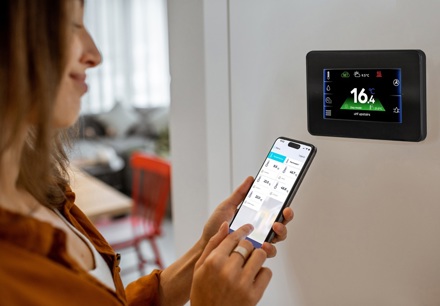
Heat pumps are increasingly being installed alongside dedicated smart controllers which, combined with Wi-Fi connectivity, allow homeowners to adjust heating schedules, monitor performance and manage hot water settings from virtually anywhere, helping them get the best possible performance from their heating system. It is not just about convenience though; features such as weather compensation for example, can automatically adjust heating output based on outdoor temperatures, helping heat pumps operate more efficiently while maintaining comfort within the home. Smart controls can also help homeowners set heating schedules that match occupancy patterns, so energy is only used when it is needed.
Heat pumps used alongside solar PV, battery storage, smart controls and electric vehicle charging, creates homes that can generate, store and manage energy more effectively. Integrated energy systems of this kind are already being trialled within housing projects, demonstrating how connected technologies can help reduce both carbon emissions and household energy bills.
The role of AI in heating systems
Alongside smart controls, AI is also beginning to play a strategic role in home energy management. It can analyse weather forecasts, occupancy patterns and electricity tariffs for example, so future systems automatically adjust operation to improve efficiency and reduce running costs. This could be a game changing development for homeowners, although it may also prompt important discussions around control, privacy and consumer choice. As these technologies evolve, transparency, cybersecurity and user control will remain important considerations in maintaining consumer confidence.
For now though, by analysing information from sources such as energy performance certificates, housing stock records and smart meters, AI can also help identify where heat pumps are likely to be most suitable and where retrofit programmes could deliver the greatest benefits. This can help local authorities and housing providers target investment more effectively, particularly in areas affected by fuel poverty.
It is an approach that also supports the delivery of Local Heat and Energy Efficiency Strategies (LHEES), which are helping councils plan the transition to low-carbon heating. Across Scotland, these strategies are identifying areas where heat pumps could be deployed at scale. In North Lanarkshire alone, around 70,000 homes have been identified as suitable for heat pump installation, while in North Ayrshire and Angus more than half of all properties are considered suitable. This information can help local authorities prioritise investment and identify areas where heating upgrades are likely to have the greatest impact.
Scotland's New Build Heat Standard has accelerated the move towards low-carbon heating and heat pumps are a big part of that picture. But smart controls, connected energy systems and emerging AI tools also have the potential to improve efficiency, reduce running costs and help homeowners get the best possible performance from their heating systems while supporting the transition to net zero.
Read more about Grant UK’s products and services here:
- Aerona 290 air-to-water heat pumps
- QR2 hot water cylinders
- Uflex underfloor heating range and Afinia aluminium radiators
- Grant UK’s in-house support for local authorities, developers and housing associations
Grant UK is an Associate Member of Homes for Scotland which this feature has been produced for.

Richard joined Grant UK in 2026 and provides tailored sales support for low-carbon heating products, including air source heat pumps, to customers in the new build and social housing sectors.
View ProfileSubscribe to Grant News
Receive the latest news and updates about Grant products and services