Products
Knowledge & Support
Explore our Knowledge Hub:
Tips & Advice Education Area Case Studies The Grant House Virtual House FAQs Glossary Visit the Knowledge HubProducts
Knowledge & Support
Explore our Knowledge Hub:
Tips & Advice Education Area Case Studies The Grant House Virtual House FAQs Glossary Visit the Knowledge HubCan you put underfloor heating under any type of flooring?
Underfloor heating systems can be installed under most common floor types but not every floor finish is equally suitable. Flooring materials with high thermal conductivity transfer heat efficiently into a room, making them better for underfloor heating systems compared to high-resistance floor coverings.
Not all floor finishes are compatible with underfloor heating because some materials restrict and resist heat transfer. The goal of an underfloor heating system is to transfer heat from the system pipework into the occupied room through the floor surface. Flooring types such as tile, stone and vinyl offer low thermal resistance and efficient heat transfer, whereas thicker wood and some carpets restrict output because they retain some of the heat.
In summary, homeowners can usually install underfloor heating beneath tiles, stone, vinyl, laminate, engineered timber, some wood flooring and some carpets, provided the installation guidelines are followed and thermal resistance limits adhered to.
Types of flooring - how do they fare for underfloor heating?
The best type of flooring to use with underfloor heating tends to be tile or stone. However, Grant has a range of compatible systems for almost every floor finish from including vinyl, laminate flooring and timber flooring.
Here, we’ve highlighted some of the common flooring types and how well they work with underfloor heating.
Do tile, stone and polished screed flooring suit underfloor heating?
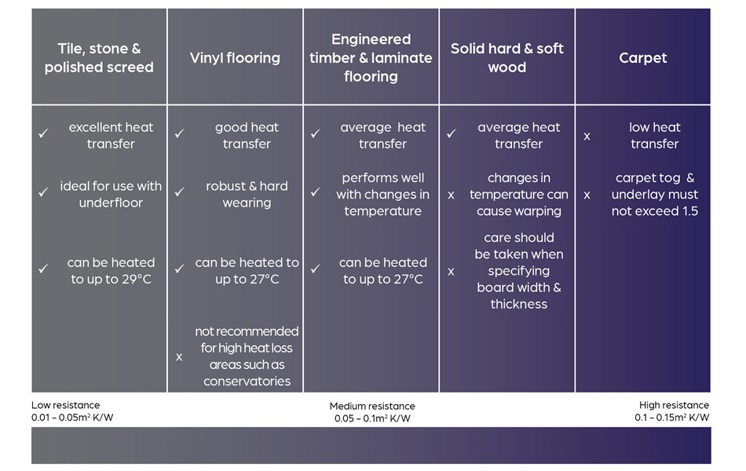
Tile, stone and polished screed flooring provide excellent heat transfer and are often the most efficient finishes for underfloor heating. These hard flooring surfaces can typically be heated to floor surface temperatures of up to 29°C in living areas, subject to system design and flooring manufacturer’s guidance. These materials help underfloor heating systems meet design room temperatures quickly because of their low thermal resistance.
Can underfloor heating go with vinyl flooring?
Vinyl flooring has good heat transfer and is generally suitable for use with underfloor heating. Most vinyl products can be heated to surface temperatures of up to 27°C but installers must check the flooring manufacturer’s maximum temperature rating. Vinyl is not recommended as a floor finish in rooms with high heat losses where higher floor temperatures are required, such as uninsulated conservatories.
Can underfloor heating work with laminate and engineered timber flooring?
Laminate and engineered timber flooring has moderate thermal resistance and performs well with underfloor heating. These floor coverings are suitable for surface temperatures up to 27°C when installed according to the flooring manufacturer’s guidelines. Engineered timber boards respond better to temperature changes compared to solid timber boards.
Can you use solid hardwood and softwood flooring with underfloor heating?
Solid hardwood and softwood flooring, can be used with underfloor heating but they are more sensitive to temperature and moisture changes which can cause warping. Very wide and thick boards increase thermal resistance and the risk of warping or cupping so care must be taken when specifying the board width and thickness. Installers must follow the timber supplier’s limits for maximum floor temperatures and heating rates when pairing solid wood with underfloor heating.
Is carpet suitable for underfloor heating?
Carpets have relatively low heat transfer compared to hard floor surfaces so they can limit underfloor heating output. For most underfloor heating systems, the combined tog value of the carpet and the UFH underlay should not exceed 1.5 tog. Homeowners must therefore check the thickness of the carpet tog and the underlay specification before installation. Thicker carpets with a higher tog feel comfortable underfoot but they can significantly reduce the transfer of heat from the underfloor heating system and the occupied room.
Comparing floor finishes for underfloor heating systems
Among common floor finishes, tile and stone deliver the highest heat output and fastest response times because they have excellent thermal conductivity. Carpet and solid wood reduce heat transfer compared to hard floor surfaces so may either require closer pipe spacing to meet design loads or may not be suitable for underfloor heating.
Here’s a quick guide to floor finishes for underfloor heating:
• Most suitable: tile, stone, polished screed and vinyl (excluding rooms with high heat losses)
• Usually suitable, subject to product specification: laminate, engineered timber
• May not be suitable: thick carpets with high tog, wide or thick solid wood boards.
Check with your flooring manufacturer
Before installation, homeowners and installers should confirm with the flooring manufacturer that the flooring product they want to use is tested and approved for us with underfloor heating systems. Following both the underfloor heating system design and flooring manufacturer’s guidelines helps to achieve efficient operation and avoid issues such as warping.
FAQs about flooring for underfloor heating
Can I retrofit underfloor heating under my existing floor?
Yes, depending on the type of floor covering you currently have and provided it is robust enough to be removed and reinstalled. Alternatively, low profile underfloor heating systems, such as Grant Uflex MINI, can be fitted on top of an existing floor covering and is ideally suited to retrofits and renovations. At just 15mm in height, the Uflex MINI underfloor system can be installed with minimal disruption to existing floor and door arrangements.
What surface temperatures are safe for different floor types?
Each type of floor finish will have different maximum surface temperatures which will be specified by the flooring manufacturer. Typically, tile, stone and polished screed can be heated up to 29ºC, whereas vinyl, laminate flooring and engineered timber can be heated up 27ºC.
Can you install underfloor heating on a suspended floor?
Yes, some underfloor heating systems can be installed on a suspended timber floor with wooden joists – read more about UFH systems for suspended floors here.
Learn more about Grant UFH
Grant’s Uflex underfloor heating system is designed for use with a wide range of screeded floor constructions and floor finishes, including tile and stone. Grant’s low-profile Uflex MINI underfloor heating system suits retrofit projects where the UFH can be laid directly on top of the existing floor covering.