Hydrotreated Vegetable Oil (HVO) is a biofuel that can be used to heat homes. Although not widely available yet, HVO biofuel has been successfully trialled using compatible oil boilers and it could help hard-to-heat homes transition to lower carbon heating. In this blog, we will explain how HVO biofuel is an alternative option to help oil boiler owners reduce their carbon emissions without needing to replace their entire heating system.
Heating Solutions for Homeowners
Are you a Heating Professional?
Products
Knowledge & Support
Explore our Knowledge Hub:
Tips & Advice Education Area Case Studies The Grant House Virtual House FAQs Glossary Visit the Knowledge HubProducts
Unsure what you need?
Use our product finder tool
Knowledge & Support
Explore our Knowledge Hub:
Tips & Advice Education Area Case Studies The Grant House Virtual House FAQs Glossary Visit the Knowledge Hub
HVO Biofuel – A future-proof solution for oil boiler owners
|
HVO biofuel gives homeowners living with an oil boiler a lower-carbon alternative fuel to conventional heating kerosene oil. Field trials have proven how HVO can be used by compatible oil boilers with limited modifications, providing off-grid homes with a solution that could significantly reduce their carbon emissions with minimal disruption. However, oil boiler owners must check their boiler’s compatibility and their local fuel supplier to have HVO biofuel readily available before making the switch.
Quick links for this blog…
In this blog, we will explain:
What is HVO biofuel for oil boilers?
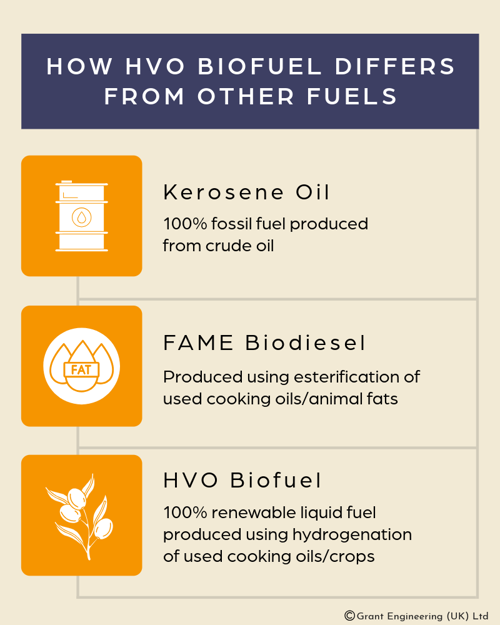
HVO, which stands for Hydrotreated Vegetable Oil, is a 100% biofuel which can be used in approved vehicles and heating applications. HVO biofuel differs from conventional fossil fuels, such as kerosene oil, used in boilers because it is produced from renewable feedstocks rather than crude oil. HVO is a low carbon liquid fuel which can be used in certain models of HVO compatible oil boilers to provide home heating.
How is HVO biofuel made?
Hydrotreated Vegetable Oil is produced using used oils such as rapeseed, sunflower and soybean oils, non-food oils and waste animal fats. Hydrogen is used in a hydrotreatment process to create a refined liquid fuel from these feedstocks resulting in the production of HVO biofuel. HVO biofuel is different to FAME biodiesel because it is produced using a different process. As with all types of fuels, the quality of HVO biofuel is dependent on the feedstock origin, sustainability certification and production processes.
How does HVO biofuel differ from heating kerosene oil?
HVO biofuel is a 100% renewable liquid fuel whereas kerosene oil is a liquid fuel distilled from a type of fossil fuel called crude oil. Kerosene oil uses finite resources and, when used in boilers, it produces carbon emissions which contribute to the greenhouse gases in the earth’s atmosphere. Meanwhile, HVO biofuel is a second-generation biofuel produced from 100% renewable waste food oils which is more sustainable than kerosene heating oil and it creates less carbon when used in home heating. In fact, field trials have shown the use of HVO can reduce carbon emissions by up to 88% compared to kerosene oil.
Why is HVO biofuel sometimes called a ‘drop-in’ fuel?
HVO biofuel is referred to as a ‘drop-in’ fuel because it is a suitable replacement fuel for existing fossil fuels. HVO biofuel is often called a drop-in fuel because heating systems using a compatible boiler can switch to HVO with few changes needed rather than replacing the complete heating system. Quite simply, a traditional fuel like Class C2 Kerosene can be removed from the storage tank of an existing oil-fired heating system, replaced with HVO biofuel and used almost straightaway (minor modifications are needed on the oil supply system and burner which we will explain later in this blog).
It is important to understand that the phrase ‘drop-in fuel’ does not imply that every oil boiler or home can use HVO biofuel – boiler compatibility checks must be made, HVO conversion adjustments may be required (in line with the burner and manufacturer instructions) and, currently, HVO biofuel is not widely available for homeowners to use.
Can my existing boiler run on HVO biofuel?
The type of boiler you have will determine whether your existing oil boiler can run on HVO biofuel. Some oil boilers, such as the current Grant Vortex range, can operate on a 30% HVO/kerosene blend with no adjustments being required. Some oil boilers are supplied as ‘HVO compatible’ which means they can use 100% HVO biofuel once a few modifications are made to their burner settings and the wider system – all current Grant Vortex floor standing oil boilers are HVO compatible. Older oil-fired boilers may not be compatible with HVO biofuel or they may only be compatible if their burner is replaced by a new HVO compatible burner.
If you are unsure whether your existing oil boiler is HVO compatible, please contact your heating engineer or if you have a Grant oil-fired boiler, you can speak to a member of our Team.

Which oil boilers are compatible with HVO biofuel?
HVO biofuel compatibility will vary between individual boiler models and will depend on boiler age, burner specification and manufacturer approvals. Some manufacturers have approved selected oil boiler ranges for HVO biofuel but it is important to note that HVO compatibility may not be applicable to all oil-fired boilers. All of Grant’s current range of Vortex floor standing boilers are HVO compatible with a few alterations, as are many earlier Grant Vortex models (excluding blue flame boilers). Therefore, if you choose one of these Vortex boilers today, you will be able to switch to HVO operation in the future if HVO biofuel becomes more readily available.
What checks should an installer complete before a HVO biofuel conversion?
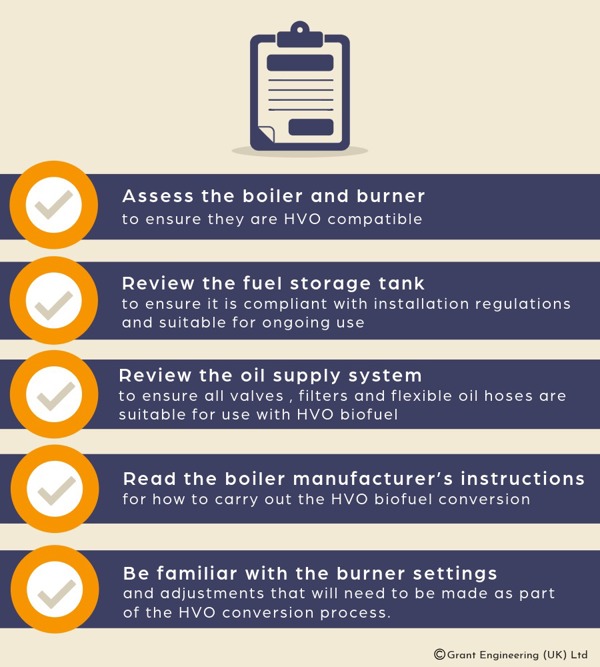
Converting an existing oil-fired boiler, running on kerosene oil, to operate using HVO biofuel should only be carried out by a qualified oil-fired heating engineer. The process of converting a Grant Vortex floor standing boiler to HVO operation is straightforward and can typically be completed as part of the boiler’s annual service. Before starting the HVO conversion process, a qualified heating engineer should carry out some checks to ensure the boiler and oil storage and supply system is compatible for HVO biofuel operation.
These checks include:
Assessing the boiler and burner to ensure they are HVO compatible
Reviewing the fuel storage tank to ensure it is compliant with installation regulations and suitable for ongoing use with HVO biofuel
Reviewing the oil supply system to ensure all valves, filters and flexible oil hoses are suitable for use with HVO biofuel
Read the boiler manufacturer’s instructions for how to carry out the HVO biofuel conversion
Be familiar with the burner settings and adjustments that will need to be made as part of the HVO conversion process.
Does HVO biofuel require boiler modifications?
Yes, for an existing boiler to be converted to operate using HVO biofuel, minor adjustments will need to be made to the boiler, burner and maybe the oil storage and supply system. HVO biofuel conversion can involve replacing the oil filter, oil nozzle on the burner and the flexible oil line with HVO compatible options, as well as carrying out thorough tests and commissioning checks on the converted system.
Most HVO biofuel conversions will require a change in oil nozzle and adjustments to the burner settings because HVO biofuel has different fuel characteristics compared to kerosene oil. When carrying out a HVO conversion, the heating engineer must refer to the relevant manufacturer instructions because each oil boiler may be different.
A typical HVO conversion process will include the following steps:
Drain the existing oil tank of kerosene and any water/sludge before replenishing with HVO biofuel, as well as draining the pipework and extracting any remaining fuel residues
Remove the existing oil filter from the tank and replace with a biofuel compatible oil filter
Remove the burner from the boiler and refer to the manufacturer’s guidance to check if it has a biofuel compatible pump
Replace the existing oil nozzle with the correct specification of nozzle for HVO for the required boiler output
Replace the flexible oil line with a HVO compatible one
Pressure test the pipework, flush the pipework with HVO, purge the fuel supply pipework of air and check for leaks
Refit the burner to the boiler, switch on the oil and electrical supply and check the oil pressure at the burner
Lastly, adjust the combustion air while using a digital combustion gas analyser to check the flue gases.
How could a HVO compatible boiler future-proof an oil-heated home?
A HVO compatible boiler could future-proof an oil-heated home by facilitating the use of a lower carbon liquid fuel should HVO biofuel become readily available. For hard-to-heat homes that are not suitable for an air source heat pump, HVO biofuel provides an alternative solution to help such properties reduce their carbon footprint without making significant, potentially cost-prohibitive changes to their home.
How can HVO biofuel reduce the disruption of decarbonising an oil-heated home?
For hard-to-heat, off-grid homes, converting their existing oil-fired heating system to use HVO biofuel can be less disruptive compared to other low-carbon heating systems. HVO compatible oil boilers can be converted to using HVO biofuel while keeping the same boiler, radiators and hot water system in place. HVO biofuel can therefore appeal to homeowners who want to reduce their dependency on fossil fuels without having to undertake a full heating system replacement.
HVO biofuel could be particularly relevant for homes where it is not feasible to install an air source heat pump. For example, some properties need significant fabric upgrades or heat emitter changes before a heat pump can perform effectively and these improvements may not always be possible because of cost or practical constraints. HVO biofuel would provide such homes with an alternative solution which could help them significantly reduce their carbon emissions immediately and with relatively low costs. These households could swap to HVO biofuel in a few simple steps and then plan for future energy-efficiency measures, such as improved insulation and draught reduction, when it is right for them.
How does HVO biofuel compare with replacing an oil boiler with a heat pump?
HVO biofuel and air source heat pumps are different technologies which can both contribute to the decarbonisation of home heating. HVO biofuel is a renewable fuel however it does still produce carbon at the point of use (ie. when it is used in a boiler). Whereas an air source heat pump uses electricity to convert low grade heat from the outside air into useable heat for the home and does not produce onsite carbon emissions during operation. Air source heat pumps, especially those which use refrigerants with a low Global Warming Potential, are a greener, more sustainable heating choice compared to HVO.

For homeowners currently using oil and seeking a renewable heat pump, financial support could be available through Government funding such as the Boiler Upgrade Scheme and Home Energy Scotland Grant and Loan Scheme. However, for homes which cannot transition to a heat pump straightaway, HVO biofuel could provide a lower-carbon heating option to kerosene oil, helping such households to start their journey to reducing carbon emissions.
What are the limits of the term “future-proof”?
The principle limitation of ‘future-proof’ in the terms of HVO is a lack of certainty. While field trials have proven how HVO biofuel can be successfully used in existing oil-fired heating systems, there is currently no guarantee of future fuel availability, lower fuel prices and wider policy support from Government to include HVO biofuel in its legislation for future home heating.
HVO biofuel is future-ready when three conditions align:
Oil boiler compatibility (field trials have proven this so hence why HVO compatible oil-fired boilers are available on the market today)
Dependable certified HVO fuel supply (currently, HVO biofuel is not widely available to consumers)
Future Government heating policies recognise HVO biofuel (currently, HVO is not included in the Government’s plans for the future of home heating).
Government policy is regularly reviewed, fuel suppliers are proactively researching more cost-effective HVO fuel supplies and product development rarely stands still. These variables are important to bear in mind when researching heating products for the future.
What are the environmental benefits of HVO biofuel?
HVO biofuel delivers environmental benefits when compared to kerosene heating oil. HVO biofuel produces less greenhouse gas emissions than kerosene and, provided traceable feedstocks and verified fuel sources are used, it is a more sustainable carbon liquid fuel. As mentioned previously, HVO biofuel still produces combustion emissions so it should not be described as zero-emission heating.
Is HVO biofuel available and affordable for UK oil boiler owners?
HVO biofuel availability and affordability are practical constraints for UK oil boiler owners. At present, HVO biofuel is not widely available to households in the UK but some fuel suppliers are sourcing and selling it. HVO biofuel typically costs significantly more than traditional kerosene heating oil.
Why does HVO biofuel usually cost more than heating kerosene?
HVO biofuel typically costs more than kerosene heating oil because it is relatively new to the market, there are limited suppliers selling it, and taxes can impact the delivered price. Organisations, such Future Ready Fuel, are working with the Government to discuss how best to introduce a new heating fuel and have proposed a pricing model which is similar to that used to help green road transportation costs.
It is anticipated that once the HVO market has grown and settled, prices should normalise and HVO biofuel prices would be subject to the usual factors which can impact costs, varying by supplier, region and fuel-duty.
HVO biofuel can give compatible oil boiler owners a practical route away from conventional heating kerosene
Although not widely available yet, it is hoped that HVO biofuel will be recognised by Government in the future to give existing oil boiler owners a greener alternative to kerosene heating oil, when a standalone heat pump is not possible for their homes. However, for those seeking a boiler replacement and looking for an option which could help them lower their carbon emissions in the future, choosing a HVO compatible oil boiler could be a great choice.
To discuss more about whether your existing boiler is compatible with HVO biofuel or to learn more about getting a HVO compatible oil boiler installed at your home, you can contact a local Grant UK G1 Installer. Speaking to a qualified heating engineer, you can discuss boiler compatibility, ask for a home heating assessment and choose the right solution for your property.
Subscribe to Grant News
Receive the latest news and updates about Grant products and services